Most small businesses spend weeks crafting their proposals, but a Contracting Officer (CO) spends only about 10 minutes on the first pass. Here's what happens on the government's end and how it impacts how you should position your business:
Step 1: They go straight to Section L and Section M.
COs focus on the instructions and evaluation criteria first, not your executive summary or cover page. They build a mental scorecard before reading your narrative. If your proposal isn't structured around those criteria, you start losing points before they even reach your content.
Step 2: They run a quick compliance check.
This includes page limits, font size, required volumes, and mandatory attachments. This process takes less than 5 minutes, and many proposals don't survive it. Technically excellent proposals get set aside simply because a company submitted a PDF when the solicitation required editable Word documents. This is not a minor detail — it can lead to elimination.
Step 3: They look for your discriminators.
COs seek specific reasons why your approach is superior to the other companies in the competitive range. "20 years of experience" is not a discriminator. Instead, something like "Delivered 97% on-time across 14 DoD task orders with zero COR complaints" is what stands out.
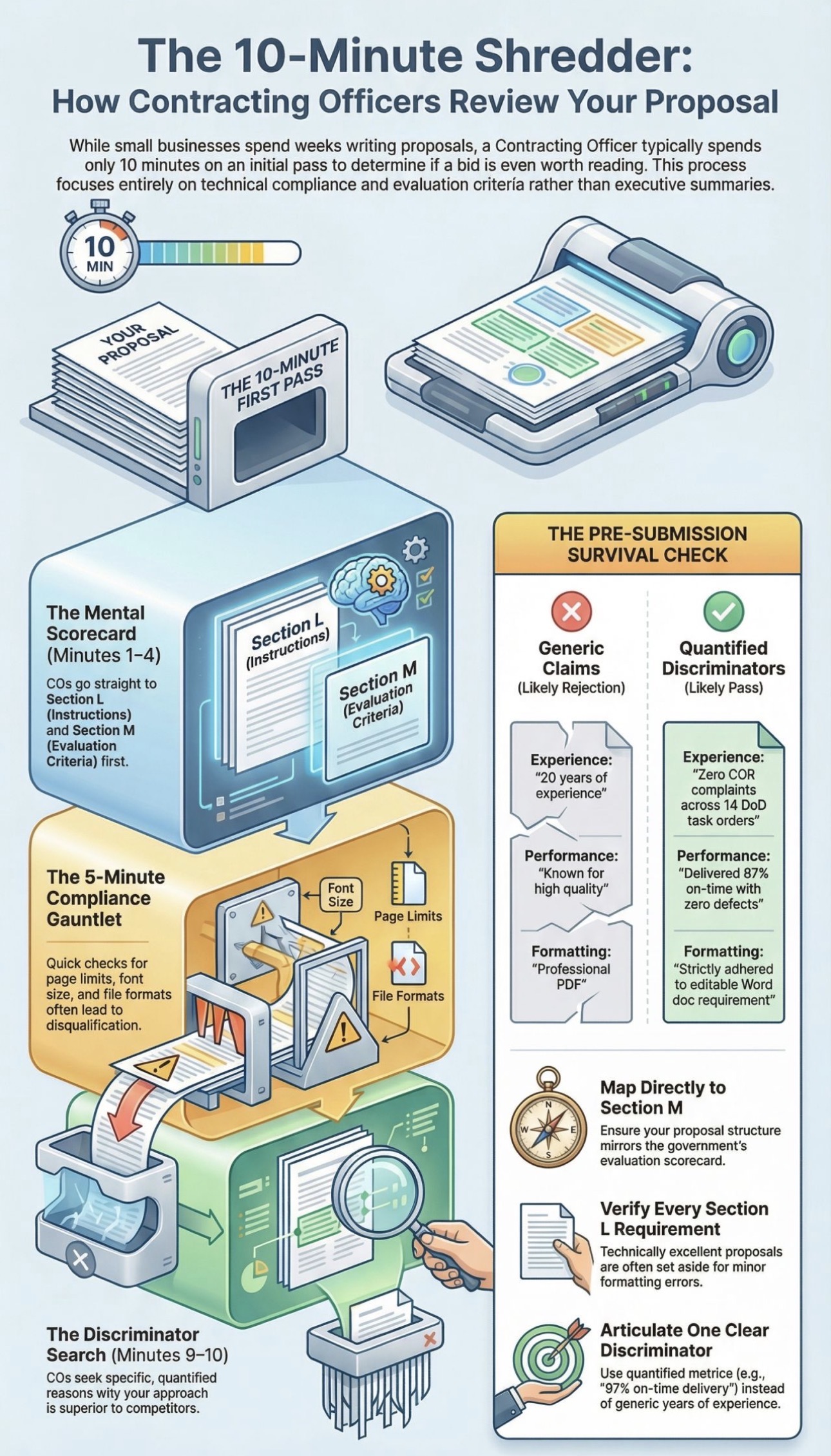
The positioning takeaway for your business:
Before you write a single paragraph, ensure you can answer these three questions:
→ Does my proposal structure map directly to Section M criteria?
→ Have I passed a compliance check against every requirement in Section L?
→ Can I articulate, in one sentence, why the government should choose me over everyone else?
If you can't answer all three, that's where you need to start.